| Product Code | Package Size | Unit of Measure |
|---|---|---|
| ANT1G-EA | Gallon Jug | Each |
| ANT1G-CA | Gallon Jug | Case of 4 |
| ANT55-EA | 55 Gallon Drum | Each |
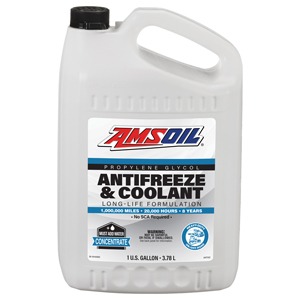
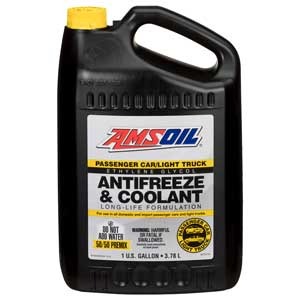
AMSOIL Propylene Glycol Antifreeze and Engine Coolant is a concentrated, long-life coolant built to protect cooling systems in passenger cars, light trucks, and heavy-duty diesel equipment far beyond the capability of conventional antifreeze products. It delivers extended drain intervals, near-perfect corrosion test scores, and compatibility with virtually every cooling system on the road.
Cooling systems face a constant assault from corrosion, scale buildup, and cavitation pitting. Conventional coolants rely on inhibitor chemistries like phosphates, nitrites, silicates, and borates that deplete over time, drop out of solution, and create the very scale deposits they were meant to prevent. In heavy-duty diesel applications, cylinder liner cavitation can eat through metal walls if the coolant chemistry isn't up to the task. Choosing the right propylene glycol antifreeze coolant is one of the most overlooked maintenance decisions in both automotive and heavy-duty applications.
NEAR-PERFECT CORROSION AND EROSION TEST SCORES
AMSOIL Propylene Glycol Coolant uses a proprietary hybrid organic acid technology (HOAT) formulation that creates a protective molecular layer on metal surfaces. Independent testing shows it achieves nearly perfect scores in ASTM corrosion and erosion testing across cast aluminum cylinder heads, steel, copper, solder, brass, cast iron, and aluminum water pumps. These results far surpass the requirements of ASTM D3306 and ASTM D6210. For vehicles with mixed-metal cooling systems, like a Ford Expedition with aluminum heads and a cast iron block, or a Cummins-powered Ram with brass radiator components, this level of broad-spectrum corrosion protection matters more than most owners realize.
VIRTUALLY ELIMINATES SCALE BUILDUP
Scale is one of the most common causes of cooling system inefficiency and overheating. Conventional coolants contain phosphates, nitrites, silicates, borates, and amines that react with calcium and magnesium minerals in water to form hard deposits on heat transfer surfaces. AMSOIL Propylene Glycol Coolant contains none of these problematic additives. Its HOAT chemistry is also highly resistant to calcium and magnesium contamination when tap water is inadvertently introduced during top-offs. This makes it a practical choice for fleet maintenance environments and field equipment like Bobcat skid loaders, John Deere tractors, and other off-road machines where distilled water isn't always available on site.
CYLINDER LINER CAVITATION PROTECTION WITHOUT NITRITES
Diesel engines with replaceable wet cylinder liners are particularly vulnerable to cavitation erosion. The rapid vibration of the liner wall creates vapor bubbles in the coolant that collapse against the metal surface, gradually pitting through the liner. Many conventional heavy-duty coolants address this with nitrite-based supplemental coolant additives (SCAs), but nitrites can cause aluminum corrosion and are being phased out by a growing number of OEMs. AMSOIL Propylene Glycol Coolant delivers outstanding performance in ASTM D7583 (John Deere Cavitation Test) testing without relying on nitrite technology. It protects cylinder liners in Cummins, Caterpillar, International, and other heavy-duty diesel engines without requiring SCA additions or extender packages.
LONG-LIFE FORMULATION THAT ELIMINATES SCA MAINTENANCE
Because AMSOIL Propylene Glycol Coolant does not require supplemental coolant additives, extenders, or recharging, it removes an entire layer of maintenance complexity. In passenger cars and light trucks, it provides protection for up to 150,000 miles or 5 years, whichever comes first. In heavy-duty and off-road applications, it extends to 1,000,000 miles, 20,000 hours of operation, or 8 years. For fleet operators running Class 8 trucks or heavy equipment with high annual hours, eliminating SCA testing and dosing schedules translates directly to reduced downtime and labor costs.
BROAD COMPATIBILITY ACROSS ALL COOLING SYSTEMS
AMSOIL Propylene Glycol Coolant is dyed neutral yellow and is compatible with all ethylene and propylene glycol antifreeze and coolant colors. It is also compatible with fully formulated diesel antifreezes, other organic acid technology (OAT) coolants, and hybrid organic acid technology (HOAT) formulations. It protects all cooling system metals, gaskets, hoses, and elastomers. Mixing propylene and ethylene glycol formulations can make freeze point prediction difficult, so if mixing for a top-off is unavoidable, AMSOIL recommends flushing the system at the next convenient opportunity.
Specifications and Approvals
AMSOIL Propylene Glycol Antifreeze and Engine Coolant meets or is suitable for use with the following specifications: ASTM D3306, ASTM D6210, ASTM D7583, ASTM D7820, TMC RP329B, TMC RP338, AS/NZS 2108.2004 Type A. It is also suitable for applications requiring Case New Holland, Cummins 14603, Cummins 3666132, DDC 7SE 298/93K217, Freightliner 48-22880, GM Heavy Truck, International Truck and Engine / Navistar CEMS B-1 Type III-A, JIS K22234, MAN 324 NF, MB DBL 7700/MB-Approval 325.3, MTU MTL 5048, Kenworth RQ26-170-97, Mack 014GS17004/014GS17009, PACCAR CS01825, DAF MAT 74002, Peterbilt 8502.002, Scania TB14511, and Volvo Heavy Truck.
Service Life
In passenger cars and light trucks: up to 150,000 miles (240,000 km) or 5 years, whichever comes first. In heavy-duty applications: up to 1,000,000 miles (1,600,000 km), 20,000 hours of operation, or 8 years, whichever comes first. No supplemental coolant additives or extenders are required. This is a concentrated product that requires mixing with distilled or high-quality water containing less than 100 ppm total hardness. At a 50 percent concentration, it provides freeze protection to -34°F (-36°C) and boil-over protection to 265°F (129°C) with a 15-psi radiator cap.
What vehicles and equipment can use AMSOIL Propylene Glycol Antifreeze and Engine Coolant?
AMSOIL Propylene Glycol Antifreeze and Engine Coolant (ANT1G-EA) is engineered for an extremely wide range of applications, including passenger cars, light trucks, motorcycles, ATVs, UTVs, snowmobiles, marine outboard engines, personal watercraft, heavy-duty on-road and off-road vehicles, and agricultural equipment. It is designed to exceed OEM requirements and is compatible with all cooling system metals, gaskets, and hoses, making it a versatile choice across nearly any liquid-cooled engine.
How does AMSOIL Propylene Glycol Antifreeze protect against corrosion and erosion?
AMSOIL Propylene Glycol Antifreeze uses unique organic acids that form a protective layer on metal components to prevent corrosion. It surpasses industry standards for metallic corrosion and erosion, achieving nearly perfect scores in ASTM corrosion and erosion testing on cast aluminum cylinder heads, steel, copper, solder, brass, cast iron, and aluminum water pumps. It also provides outstanding cavitation and pitting protection for cylinder liners, demonstrated by its performance in ASTM D7583 (John Deere Cavitation Test) testing.
What specifications does AMSOIL Propylene Glycol Antifreeze and Engine Coolant meet?
AMSOIL Propylene Glycol Antifreeze and Engine Coolant is engineered to exceed OEM and ASTM D3306 requirements. It provides freeze protection down to -34°F (-36°C) and boil-over protection up to 265°F (129°C) when used with a 15-psi radiator cap. It is phosphate-, nitrate-, nitrite-, silicate-, borate-, and amine-free, which are the additives commonly found in conventional coolants that cause scaling issues.
How does AMSOIL Propylene Glycol Antifreeze compare to conventional antifreeze coolants?
Unlike conventional antifreeze and coolant formulations that contain phosphate, nitrite, silicate, borate, and amine — which are responsible for almost all scaling issues — AMSOIL Propylene Glycol Antifreeze is free of all these additives. This means it virtually eliminates scaling problems and is also resistant to calcium and magnesium contamination if tap water is inadvertently introduced. Its organic acid technology provides superior long-life corrosion protection compared to conventional coolants, with service life up to 150,000 miles in passenger vehicles or up to 1,000,000 miles in heavy-duty applications.
How long does AMSOIL Propylene Glycol Antifreeze and Engine Coolant last before it needs to be changed?
AMSOIL Propylene Glycol Antifreeze and Engine Coolant provides protection for up to 150,000 miles (240,000 km) or 5 years, whichever comes first, in passenger cars and light trucks. In heavy-duty applications, it offers protection for up to 1,000,000 miles (1,600,000 km), 20,000 hours of operation, or 8 years, whichever comes first. It is sold as a concentrate and requires mixing with distilled or high-quality water before use.
Is AMSOIL Propylene Glycol Antifreeze compatible with other coolant colors and safe for all cooling system components?
Yes, AMSOIL Propylene Glycol Antifreeze and Engine Coolant is compatible with all other antifreeze and coolant colors, so it can be used regardless of what coolant was previously in the system. It is formulated to protect all cooling system metals, gaskets, and hoses. Its phosphate-, nitrite-, silicate-, borate-, and amine-free formula helps prevent scaling and deposit buildup that can damage cooling system components over time.
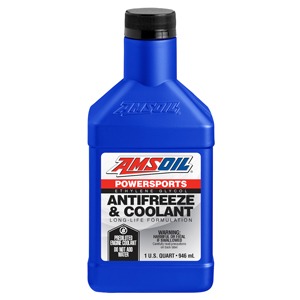

 Product Details PDF - AMSOIL PROPYLENE GLYCOL ANTIFREEZE AND ENGINE COOLANT